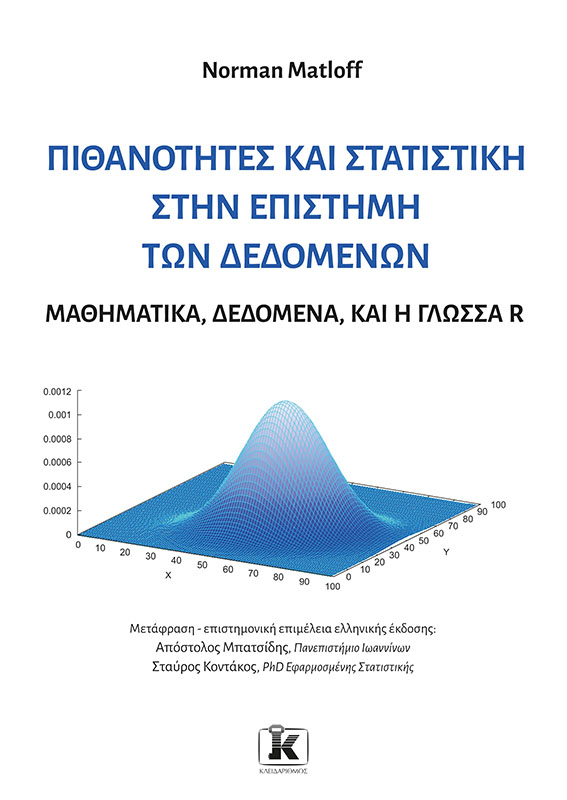
The book Probability and Statistics in Data Science is concerned with "mathematical statistics" (families of distributions, expected values, estimation of values, etc.), but it places particular emphasis on the "data science" part of the title : With extensive use of data sets from real, everyday cases With programs, written in the R language, that support data analyzes With references to many data science applications, such as, among others, principal component analysis (PCA), mixing distributions, random graph models, hidden Markov models, neural networks, and linear and logistic regression With appropriate guidance of students, helping them to critically examine the "hows" and "whys" of statistics and to see the big picture in any case By formulating concepts and models in a mathematically precise way, but without adhering to the classic dichotomy of "formulating the theorem and proving it" The prerequisite knowledge that is good to have in order to use the book is some knowledge of calculus and matrix algebra, as well as some experience in computer programming. Contents: Basic Probability Models Monte Carlo Simulation Discrete Random Variables: Expected Value Discrete Random Variables: Variance Discrete Parametric Families of Distributions Continuous Probability Models Statistics: Introduction Fitting Continuous Models The Family of Normal Distributions Introduction to Statistical Inference Multivariate Distributions The Family of Multivariate Normal Distributions Mixture Distributions Multivariate Data: Description and Dimensionality Reduction Techniques Predictive Modeling Model Parsimony and Overfitting Introduction to Discrete-Time Markov Chains Quick Introduction to R Matrix Algebra